Open-source software that turns a Raspberry Pi Compute Module 5 and a touchscreen into a standalone four-part synthesizer — four engines, one filter, and one cable to your DAW.
Voice4 engines, 24 voices, one filtermulti-timbral · 4 parts · independent modulation
Shape24 morph transitionsone continuous gesture across every engine
Signal8-channel audio + MIDIclass-compliant · to any DAW over one cable
ScriptLuasequences, DSP, screen drawing
01 / Engines
Four voices, four lineages.
Brume runs four synthesis engines with a shared voice tail (state-variable filter, amp envelope, modulation router), so patches stay coherent across very different sources. Each engine has its own mechanism for continuous spectral change: algorithm routing and per-voice FM-index envelopes in FM, a scanning window in Harmonic, cascaded wavefolding in Timbral, grain scatter in Granular. No samples sit anywhere in the signal path; every voice is generated from live math.
◆ Part 1 · FM
FM
Metallic overtones from stacked sines
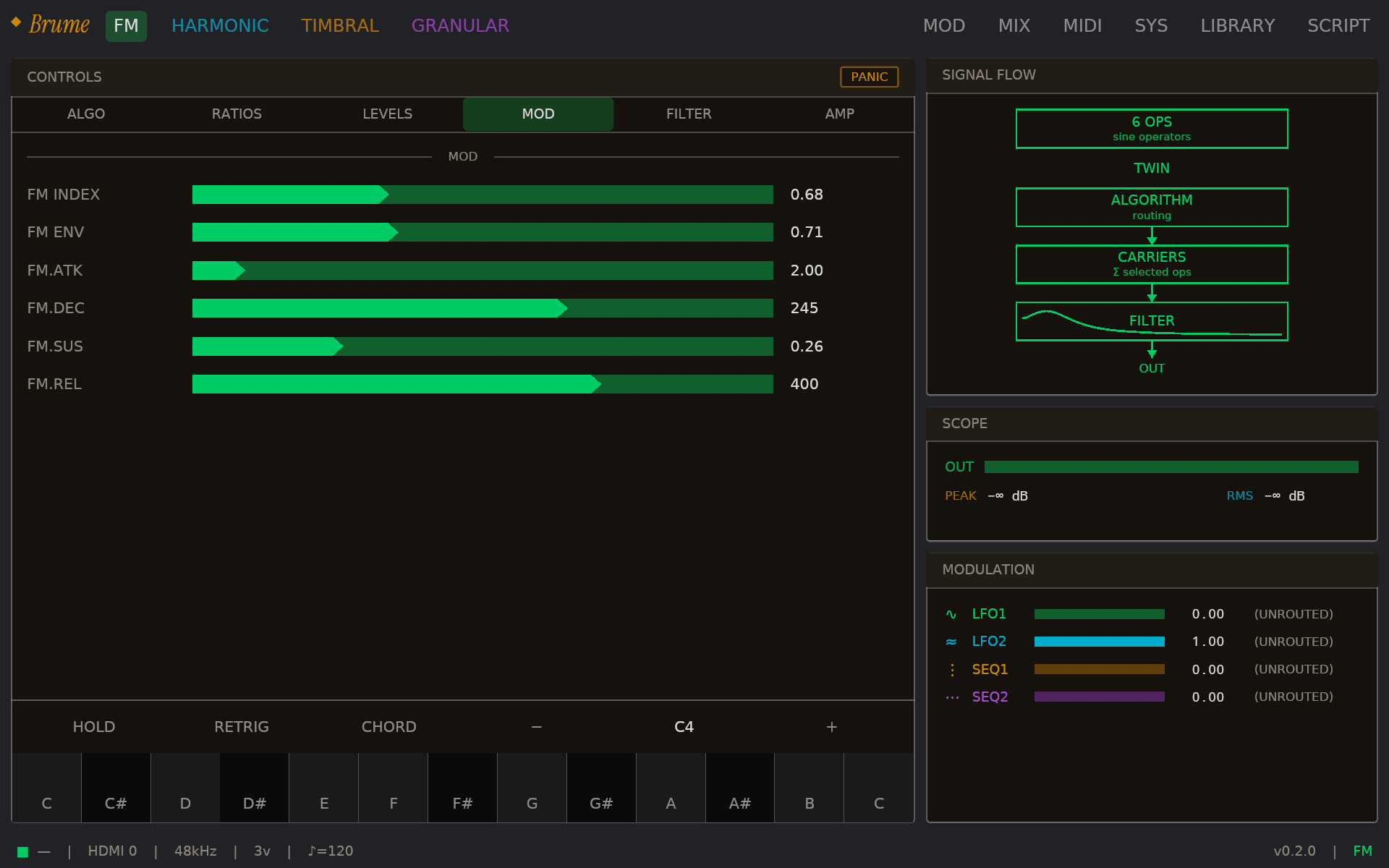
Six operators across twelve algorithm topologies, per-op ratio and level, global feedback, a per-voice FM-index envelope, and a voice-tail state-variable filter with its own envelope — DX-style FM with subtractive shaping on the way out.
6-OP12 ALGOSFDBKINDEX ENVFILTER
◆ Part 2 · Harmonic
Harmonic
Additive synthesis under a scanning window
Eight harmonics with Gaussian scanning, per-harmonic waveform morph, FM on the fundamental, spectral tilt, and odd/even balance.
SCANMORPHTILTODD/EVNSPREAD
◆ Part 3 · Timbral
Timbral
Triangle core folded into nonlinear spectra
Triangle core through a wave-multiplier shaper with linear FM, sub-oscillator, self-modulation feedback, and expanded symmetry.
TIMBRESYMMETRYMULTIPLYLIN FMSUB
◆ Part 4 · Granular
Granular
Pitched grain clouds that drift and scatter
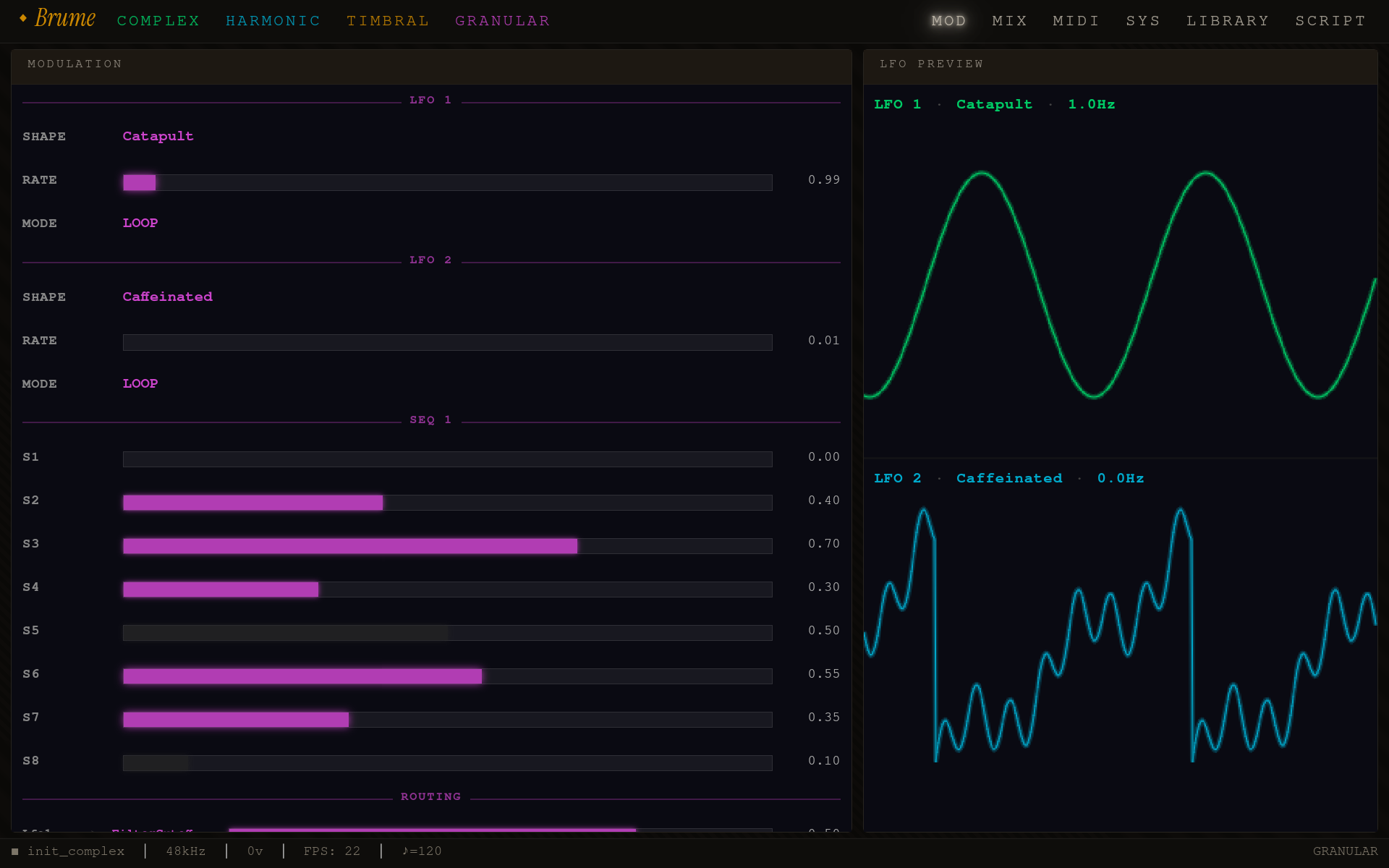
Pitched clouds of micro-oscillator grains with morphable waveforms. Density, scatter, drift, and FM within grains.
DENSITYSCATTERDRIFTMORPHFM
02 / Signal architecture
Every voice, the same path.
MIDI in, voice allocation, modulation, filter, envelope, mixer. Sends to delay and reverb. A Lua FX slot for custom processing.
03 / Meridian
One cable to your DAW.
One USB cable carries multi-channel audio out, bidirectional MIDI, and clock. Class-compliant — no drivers, no manager app.
CM5 IO Board with USB OTG for multi-channel audio and MIDI to your DAW. HDMI, GPIO, Ethernet.
03 · Display
Touchscreen
Pick the HDMI touchscreen that fits your build. Brume’s UI is designed around a 1024×600 logical layout and auto-scales to whatever panel you connect — tap into the CM5 touchscreen ecosystem. Reference unit: 10.1″ 1920×1200.
04 · Software
Software
Brume installs onto Raspberry Pi OS Lite. The brumectl CLI adds the runtime packages, labwc/webkitgtk shell, audio config, presets, and systemd service; --update refreshes the binary and factory presets over SSH.
Controllers
05 · Reference controller
Controller
Korg nanoKONTROL2 is the reference USB-MIDI controller — 8 knobs, 8 faders, transport, and per-strip S/M/R. Brume ships with a default CC-mapping JSON plus a Lua starter script.
06 · Deep-control surface
Deep surface
Novation Launch Control XL 3 positions as the deeper control option — 24 endless encoders, 8 faders, 16 pads, transport. In development as a first-class surface: dedicated CC-mapping JSON with a per-engine page layout, Lua starter scripts.
07 · Open control layer
Extend
Plug in a class-compliant MIDI controller, touch MIDI learn, save the mapping, then shape the behavior in Lua. Map a controller you like, then share the mapping and a starter script so everyone gets it out of the box.
01MIDI learn
02Lua behavior
03Contribute support
◆ Getting Started
Parts in. Instrument out.
Off-the-shelf hardware and a single command. From a Compute Module 5 to a playable instrument.
01
Assemble
A Compute Module 5 on a carrier board, with a touchscreen.
The carrier’s USB-OTG port is what bridges Brume to your DAW. Running Pi OS Lite, on your network.
02
Install
Two commands from your computer. The first installs brumectl; the second sets Brume up on the Pi over SSH.
curl -fsSL https://brume.aftertone.co/install | sh
brumectl install <device-host>
~3–5 min. brumectl fetches the matching Brume release, configures the device, and sets it to launch on boot.
03
Play
It boots straight into Brume. Play its four parts from the touchscreen, a MIDI keyboard, or a control surface.
One USB cable presents it to your DAW too — audio, MIDI, per-part stems.